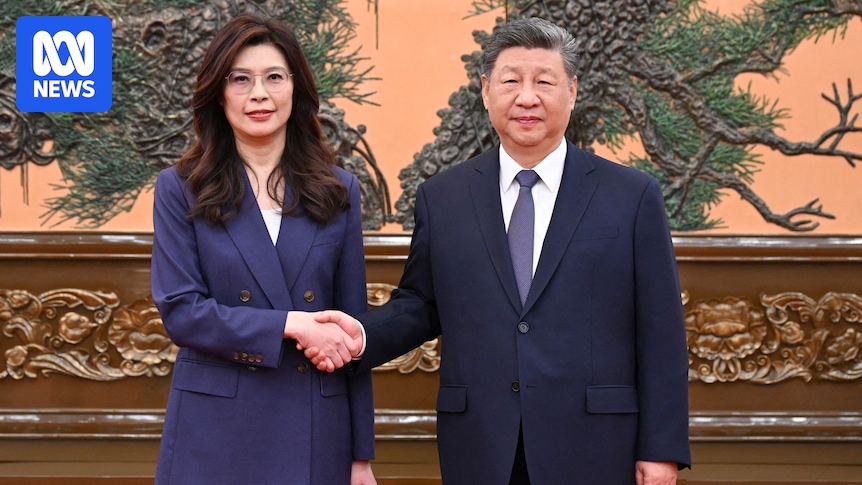
Cheng Li-wun & Xi Jinping: KMT's Peace Bridge for Cross-Strait Stability
In a diplomatic maneuver that captured global attention, Taiwan's main opposition leader, Cheng Li-wun, embarked on a landmark visit to China, culminating in a rare meeting with President Xi Jinping. Hailed by the Kuomintang (KMT) as an endeavor to construct a "bridge for peace," this high-level engagement sought to thaw the frozen channels of communication between Beijing and Taipei, underscoring the KMT's traditional role in fostering cross-strait stability.
The encounter between Cheng Li-wun and Xi Jinping at China's Great Hall of the People on Friday marked a significant moment, being the first time an incumbent KMT chairperson visited the mainland in a decade. This overture comes at a time when cross-strait tensions are notably high, with Beijing increasingly vocal about its claim over Taiwan and its refusal to engage with the Democratic Progressive Party (DPP) government under President Lai Ching-te.
A Decade in the Making: Cheng Li-wun's Landmark Visit
Cheng Li-wun's trip to China, spanning Shanghai, Nanjing, and Beijing, was more than just a routine diplomatic exchange; it represented a strategic recommitment by the KMT to its long-held philosophy of engagement with the mainland. As the first sitting KMT leader to visit China in ten years, Cheng's proactive stance contrasted with some predecessors' more cautious approaches, reflecting an urgency to de-escalate potential conflicts.
Since 2016, when the DPP's Tsai Ing-wen became president, Beijing has severed high-level communications with Taiwan. The core of this diplomatic freeze lies in the DPP's consistent refusal to endorse the "One China" concept, a fundamental prerequisite for dialogue from Beijing's perspective. With President Lai Ching-te, whom Beijing labels a "separatist" and "troublemaker," now at the helm, the communication blockade has intensified. In this context, the KMT, under Cheng Li-wun, stepped into the void, positioning itself as the only viable interlocutor for peace and dialogue.
Cheng openly stated her intention to be a "bridge for peace," an aspiration that resonated with KMT's historical mandate of promoting peaceful cross-strait development. This visit serves as a vital reminder that even amidst geopolitical complexities, dialogue, however challenging, remains a critical tool for preventing escalation. For more detailed insights into the challenges and criticisms surrounding her visit, you can read Cheng Li-wun's China Trip: Taiwan's KMT Navigates Peace Amid Criticism.
Bridging Divides: The Core Message of Peace and Stability
The primary agenda for both Cheng Li-wun and Xi Jinping was unequivocal: safeguarding peace and stability across the Taiwan Strait. President Xi, addressing Cheng, articulated a vision of shared destiny: "The leaders of our two parties are meeting today in order to safeguard the peace and stability of our shared homeland, to promote the peaceful development of cross-strait relations, and to allow future generations to share in a bright and beautiful future." He emphasized China's willingness to strengthen exchange and dialogue, albeit under the explicit condition of opposing Taiwan independence.
Cheng Li-wun echoed this sentiment, framing the "rejuvenation of the Chinese people" as a shared aspiration that would contribute positively to world peace and human progress. Her commitment to preventing tragedy and fostering cooperation resonated with many who fear the economic and human costs of conflict. This dialogue, while contentious for some, offers a potential pathway for de-escalation by ensuring that at least one major Taiwanese political party maintains open lines with Beijing.
Practical Tip: Understanding the language used by both sides is crucial. Terms like "shared homeland" and "rejuvenation of the Chinese people" are loaded with historical and political context, signaling a desire for a unified future from Beijing's perspective, while the KMT uses them to advocate for cultural and economic ties within a framework that, for now, maintains the status quo.
The 1992 Consensus and the Taiwan Independence Red Line
A central pillar of the discussions, and indeed the KMT's cross-strait policy, was the 1992 Consensus. Cheng Li-wun explicitly stated that maintaining the 1992 Consensus and opposing Taiwan independence were pathways to "avoid war, prevent tragedy, work together and create peace." The 1992 Consensus is an understanding reached between the KMT and the Chinese Communist Party (CCP) that acknowledges "one China" but allows for differing interpretations of what that "one China" means. For the KMT, it historically provided a framework for engagement without immediately compromising Taiwan's autonomy.
Beijing, for its part, consistently demands adherence to the "One China principle" and views the 1992 Consensus as the foundation for any cross-strait dialogue. Xi Jinping reiterated that "those on both sides of the Taiwan Strait are Chinese" and that they "all wanted peace," but this peace is contingent on rejecting Taiwan's formal independence. This stance puts Beijing in direct opposition to the DPP, which rejects the 1992 Consensus, arguing that it undermines Taiwan's sovereignty and self-determination.
The KMT's advocacy for the 1992 Consensus, especially in direct communication with Xi Jinping, highlights the party's belief that this framework is the most pragmatic way to manage relations with Beijing and avert conflict. For a deeper dive into the significance of this meeting and the specific demands, refer to Xi Jinping Meets Cheng Li-wun: One China, 1992 Consensus, and Taiwan's Future.
Navigating Domestic and International Scrutiny
While hailed by the KMT as a peace mission, Cheng Li-wun's visit faced considerable criticism within Taiwan. The ruling DPP accused her of being "subservient" to Beijing, suggesting that such visits weaken Taiwan's international standing and embolden China's claims. These criticisms reflect a deep ideological divide within Taiwan about how best to manage relations with its powerful neighbor.
The majority of people in Taiwan consider themselves a sovereign nation, and public opinion often favors maintaining the "status quo" – neither unifying with China nor formally declaring independence. This delicate balance means that any high-profile engagement with Beijing, particularly one that reiterates the 1992 Consensus, is subject to intense scrutiny. It forces Taiwanese political leaders to walk a tightrope, attempting to secure peace while safeguarding the island's de facto autonomy and democratic values.
Insight: The KMT's strategy, while drawing criticism, aims to present a pragmatic alternative to what it perceives as the DPP's confrontational approach. By maintaining a channel, however imperfect, the KMT hopes to demonstrate its commitment to stability and its capability to de-escalate tensions, potentially appealing to a segment of the Taiwanese electorate weary of cross-strait friction.
The meeting between Cheng Li-wun and Xi Jinping is a potent reminder of the intricate and often volatile nature of cross-strait relations. While Cheng Li-wun sought to lay down a peace bridge, the foundational issues of sovereignty, national identity, and the future of Taiwan remain profoundly unresolved. The KMT's efforts to foster dialogue, even under Beijing's strict conditions, underscore a complex political landscape where different approaches vie for the path to peace and stability in a region of immense geopolitical importance.